
[ WATTSTEP / TECHNICAL INSIGHTS ]
Axial Flux Motor
How it works, benefits and applications
A closer look at the geometry behind axial flux machines, the choices that shape their performance and where they can fit in an electric drive system.
What is an axial flux motor
In an axial flux motor, the magnetic flux runs parallel to the shaft. The active parts are arranged in a disc-shaped package rather than the familiar cylindrical form of a radial flux machine.
This geometry opens up different packaging possibilities. The right machine still depends on the required torque, operating speed, cooling and available space.
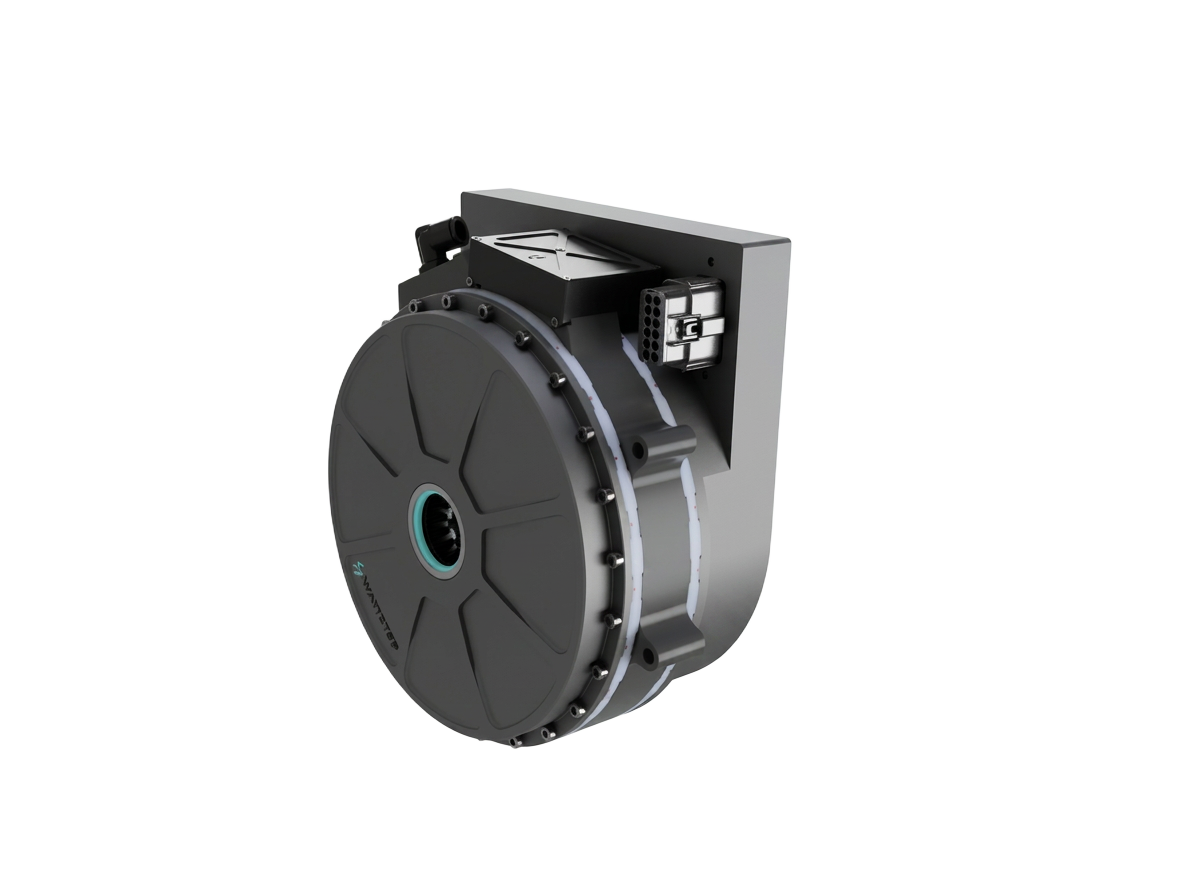
How it works
Current flowing through the stator windings creates a rotating magnetic field. Its interaction with the rotor produces torque, turning the shaft. The inverter controls the current to regulate the motor's operation.
Rotor layout, winding arrangement, air gaps and thermal paths all influence the final machine. Motor and inverter therefore need to be considered together.
Axial flux vs radial flux
Neither geometry is a universal answer. This introductory comparison outlines common differences, not a performance ranking.
| Characteristic | Axial flux | Radial flux |
|---|---|---|
| Flux direction | Parallel to the shaft | Across the shaft |
| Typical geometry | Disc-shaped | Cylindrical |
| Packaging | Short axial length, larger diameter | Longer axial package, diameter varies |
| Cooling considerations | Disc surfaces, windings and rotor heat paths | Stator jacket, windings and rotor heat paths |
| Design choice | Depends on the duty cycle and installation | Depends on the duty cycle and installation |
Benefits and trade-offs
A short axial package and a broad active diameter can make axial flux attractive where length is constrained. High torque density and system integration are important opportunities.
The trade-offs include diameter, rotor mechanics, air-gap control and cooling. A fair assessment considers the complete duty cycle and installation rather than one headline figure.
Applications
Potential applications include electric vehicles, industrial equipment and compact drive systems. A short motor package can create room for other parts of the machine or support a different drivetrain layout.
Application suitability depends on load, speed range, cooling, environmental conditions and integration requirements.
Rare-earth-free and magnet-free axial flux motors
Axial flux describes a machine's geometry, not whether it contains magnets. Rare-earth-free and magnet-free are also different claims: a magnet can use materials other than rare earths, while a magnet-free machine uses a different excitation approach.
WattStep's standard permanent magnet motors are designed without heavy rare earth materials. That does not mean they are magnet-free or free of every rare earth material. Magnet-free axial flux technology is a separate research topic.
How WattStep's motors compare (benchmark)
A meaningful benchmark compares figures under the same operating conditions: voltage, cooling, duty cycle and the mass included in the measurement. Peak and continuous ratings should be kept separate.
This section is reserved for the final benchmark commentary. In the meantime, the product page lists WattStep's own AFMPM-I400 and AFMPM-F400 specifications.
FAQ
What is an axial flux motor?
An axial flux motor is an electric machine in which magnetic flux travels parallel to the shaft. Its disc-shaped geometry can provide a short axial package.
How is axial flux different from radial flux?
Axial flux machines direct magnetic flux along the shaft, while radial flux machines direct it across the shaft. The choice depends on packaging, speed, cooling and the application.
Are all axial flux motors magnet-free?
No. Axial flux describes the geometry, not the magnet material. Permanent magnet and magnet-free designs are distinct approaches.
Which WattStep products use axial flux technology?
WattStep's AFMPM-I400 and AFMPM-F400 are standard axial flux permanent magnet motors. See the motor product page for specifications.