
[ WATTSTEP / TECHNICAL INSIGHTS ]
Axial Flux Motors Without Heavy Rare Earth Metals – and Magnet-Free
No dysprosium, no terbium, verified performance
WattStep is a Swedish developer and manufacturer of axial flux motors and integrated inverters, based in Gothenburg. Our standard motors, the AFMPM-F400 and AFMPM-I400, are built without heavy rare earth metals: no dysprosium and no terbium is added to their magnets.
This page explains why rare earth metals have become a problem for electric motor manufacturing, what the difference between light and heavy rare earths means in practice, and how WattStep's design avoids the heavy ones without giving up permanent magnet performance. It also covers the magnet-free axial flux motor we are developing together with Chalmers University of Technology.
Why rare earth metals are a problem for electric motors
Most high-performance electric motors use neodymium iron boron (NdFeB) permanent magnets. They give the strongest magnetic field per unit weight of any commercial magnet material, which is why they sit in traction motors for electric vehicles, marine propulsion, aviation and industrial machines.
The problem is not neodymium itself but what is added to it. To keep NdFeB magnets magnetized at high operating temperatures, manufacturers add heavy rare earth elements such as dysprosium and terbium. These elements are scarce, expensive and price-volatile, and their supply is heavily concentrated in China.
That concentration creates a real business risk for anyone building or buying electric motors. Export restrictions can cut availability with little warning, and price shocks move straight into the cost of the motor. A drivetrain program that depends on dysprosium or terbium carries a supply chain exposure that is hard to insure against.
There is also an environmental dimension. Mining and refining rare earth elements is energy-intensive, and the CO2 footprint of the magnet material is a growing part of the total footprint of an electric machine. Reducing the rare earth content of a motor, and above all removing the heavy rare earths, improves both the supply situation and the environmental balance.
Light vs heavy rare earth metals: what neodymium, dysprosium and terbium do in a motor
Rare earth elements are a group of seventeen elements, and they are not equally critical. In a permanent magnet motor, two categories matter: the light rare earths and the heavy rare earths.
Neodymium is a light rare earth element. It is the base of the NdFeB magnet and gives the magnet its strength. Neodymium is produced in comparatively large volumes and is available from a wider set of sources than the heavy rare earths.
Dysprosium and terbium are heavy rare earth elements. They do not make the magnet stronger; they make it keep its strength at high temperature. A magnet without them loses magnetization when the motor runs hot, so manufacturers add them as insurance against demagnetization. They are mined in small volumes, their prices swing sharply and their supply is the most concentrated of the rare earth group.
The distinction matters when a motor maker talks about rare earth content. A motor without heavy rare earth metals still contains neodymium, and a motor without any rare earths at all must replace the permanent magnet itself. These are different engineering problems with different solutions.
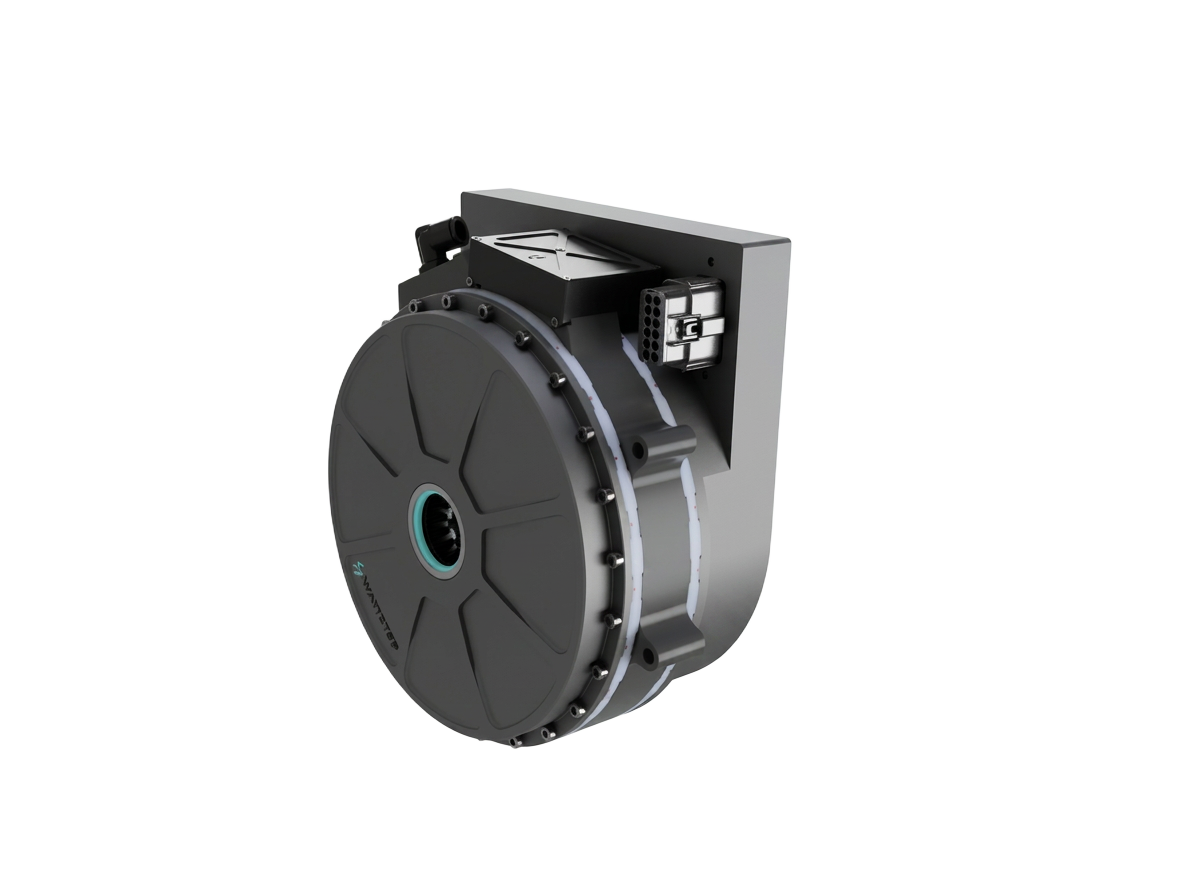
WattStep's NdFeB axial flux motors without heavy rare earth metals
WattStep's AFMPM-F400 and AFMPM-I400 use neodymium (NdFeB) permanent magnets but are designed without heavy rare earth metals: no dysprosium and no terbium is added to the magnets. Two design choices make that possible.
First, the machines are fully oil-cooled. Oil flows in direct contact with the active parts and carries heat away from the magnets, keeping them within the temperature range where standard neodymium grades keep their strength. The cooling system does the job that dysprosium and terbium would otherwise do.
Second, the axial flux geometry works in the same direction. The short magnetic flux path of an axial flux machine reduces losses in the magnetic circuit, so less heat is generated in the first place and the thermal load on the magnets is lower.
The result is a verified product, not a concept. The F400 delivers 585 Nm peak torque and a peak torque density of 24.4 Nm/kg at 24 kg, and the I400 delivers 227.6 kW peak power at the same weight, both rated to 9 000 rpm. Removing the heavy rare earths has not cost performance.
Note the precise claim: these motors are designed without heavy rare earth metals. They are not rare-earth-free, because neodymium is a rare earth element, and they are not magnet-free. For applications that must avoid rare earth elements entirely, the answer is the electrically excited motor described below.
Magnet-free: the electrically excited axial flux motor
For applications that must avoid rare earth elements entirely, WattStep is developing a magnet-free, electrically excited axial flux motor. In an electrically excited machine, the rotor is magnetized electrically, with current through windings, instead of with permanent magnets. The motor therefore needs no rare earth magnets at all.
The project is developed together with Chalmers University of Technology and industry partners, and is funded by the Swedish Energy Agency (2024). The idea came from customer discussions about supply chain robustness: customers wanted a high-performance motor whose bill of materials does not depend on rare earth supply at all.
Results were presented at ICEM 2026, the 27th International Conference on Electrical Machines in Funchal, Madeira, in the study "Saturation effects in Axial Flux Electrically Excited Synchronous Machines". The study shows performance on par with permanent magnet machines.
The electrically excited motor is in development and is not a product yet. What it demonstrates is that the axial flux geometry works with electrical excitation, and that a magnet-free axial flux motor can reach permanent magnet performance levels.
Comparison of magnet strategies
The table below compares the three magnet strategies for a high-performance axial flux motor: conventional NdFeB with heavy rare earths, WattStep's NdFeB design without heavy rare earths, and the electrically excited magnet-free machine.
| Strategy | Magnet type | Light rare earths | Heavy rare earths | Supply risk | Maturity / availability |
|---|---|---|---|---|---|
| NdFeB with heavy rare earths | NdFeB permanent magnets with added dysprosium and terbium | Yes (neodymium) | Yes (dysprosium, terbium) | High; concentrated supply, export restrictions and price volatility | Mature; the established high-performance standard |
| WattStep NdFeB without heavy rare earths | NdFeB permanent magnets, no added dysprosium or terbium | Yes (neodymium) | No | Lower; no exposure to the most supply-critical rare earths | Verified standard product; F400 and I400 |
| Electrically excited (magnet-free) | No magnets; electrically excited rotor | No | No | Lowest; no magnet material at all | In development with Chalmers; not a product yet |
FAQ
Yes. An electrically excited axial flux motor creates the rotor magnetic field with current through windings instead of permanent magnets, so it needs no rare earth magnets at all. WattStep develops such a motor together with Chalmers University of Technology, funded by the Swedish Energy Agency, and results presented at ICEM 2026 show performance on par with permanent magnet machines. It is in development, not a product yet.
An electrically excited synchronous motor magnetizes its rotor electrically, with current through windings, instead of with permanent magnets. Because there is no magnet material in the rotor, the motor needs no rare earth elements at all.
Dysprosium is added to neodymium (NdFeB) magnets so they keep their magnetization at high operating temperatures. It is one of the heavy rare earth elements: scarce, expensive, price-volatile and with supply heavily concentrated in China. WattStep's motors avoid it through direct oil cooling that keeps the magnets within the temperature range where standard magnet grades perform.
Yes. The AFMPM-F400 and AFMPM-I400 contain neodymium, which is a light rare earth element, in their permanent magnets. They contain no heavy rare earth metals: no dysprosium and no terbium is added to the magnets.
No. The F400 and I400 are designed without heavy rare earth metals, which is the precise claim. They still use neodymium magnets. Only the electrically excited axial flux motor in development is magnet-free and needs no rare earth magnets at all.
No. The electrically excited axial flux motor is a development project run together with Chalmers University of Technology and industry partners, funded by the Swedish Energy Agency. It is not a product yet.